The Procold Relaunch: How a 37 Year Old Brand Won Over Younger Nigerians
Ask any Nigerian over 30 what their mother reached for when the whole house started sneezing, and there’s a good chance you’ll hear one name: Procold.
For about 37 years, Procold has been a fixture in the cold and catarrh category of Nigeria’s pharmaceutical market. It sat in family medicine cabinets, in handbags, on the counters of the corner chemist. It earned its place the hard way, by working.
So when Procold came to Adway Africa, the brief wasn’t to fix a broken product or rescue a damaged reputation. It was something quieter and, honestly, harder, and it’s a challenge we see more and more in pharmaceutical marketing in Nigeria. Nigerians already trusted Procold. The problem was who they trusted it for.
As an advertising agency in Nigeria, we see plenty of briefs, but this one stayed with us. Here’s how we helped a 37-year-old pharmaceutical brand speak to a generation that had politely filed it under “my parents’ medicine”.
The Problem: Trusted, But Not for Them
Procold didn’t have an awareness problem. Almost everyone knew the name. It didn’t have a quality problem either; the product had decades of results behind it.
What it had was a generational gap. Younger Nigerians, the students, young professionals and new parents now making their own health choices, saw Procold as a brand for the older generation. Respected, yes. Familiar, definitely. But not theirs. Anyone who has worked on marketing to Gen Z in Nigeria will recognise the pattern: respect for a brand doesn’t automatically turn into preference.
That matters more than it sounds. A brand that people “grew up with” carries real goodwill, but goodwill alone doesn’t move a young shopper standing in a pharmacy. Left alone, that nostalgia slowly turns from an asset into a ceiling. Meanwhile, newer brands with sharper packaging and a louder digital presence were happy to step into the space Procold had quietly left open.
The Insight: Trust That Belongs to Someone Else
Our research kept circling back to one idea, and once we saw it, we couldn’t unsee it.
Nigerians can trust a brand completely and still believe it’s meant for someone else.
Younger consumers weren’t doubting Procold. In their minds, it went something like this: “Procold worked for our parents and grandparents. It still works. But that’s the old way, and we want something modern.”
That changed the whole brief. We didn’t need to prove Procold was effective; nobody was questioning that. We needed to close the distance between the brand and the people we wanted to reach, so that a 24-year-old in Lagos could look at Procold and see something made for their life, not their father’s.
The Strategy: Three Pillars
We built the relaunch on three ideas, and every creative decision had to answer to them.
- Reframe the legacy, don’t hide it. It would have been easy to bury Procold’s history and pretend to be new. We did the opposite. Thirty-seven years of reliability became the proof point: in a market full of unknown names, this is the one that has never let Nigerian families down.
- Modernize the voice. We changed how the brand looks and sounds so it matches how younger Nigerians actually communicate: more direct, more visual, and at home on the platforms where they spend their time.
- Show up where relevance is earned. Instead of one loud campaign moment, we planned for sustained presence across digital and traditional media, so Procold reentered everyday conversation rather than interrupting it once and disappearing.
The Execution: New Look, Same Efficacy
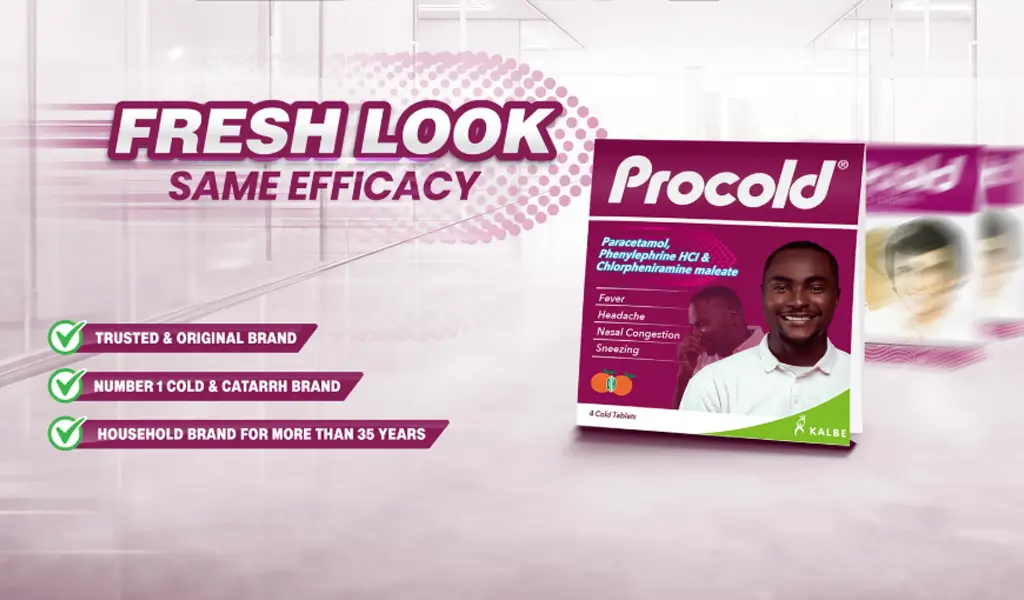
The heart of the work was a brand refresh, not a full rebrand. It’s a distinction any good rebranding agency in Nigeria should help a client think through: a rebrand changes who you are, while a refresh changes how you’re seen. We updated Procold’s look into something modern and widely acceptable to younger consumers, while making sure nothing about the product itself was in question. That balance gave the campaign its name and its promise: New Look, Same Efficacy.
The line did two jobs at once. To younger Nigerians, it said: this brand has caught up with you. To the loyal customers who had trusted Procold for years, it said: relax, the medicine you know hasn’t changed.
We then amplified the refresh through an integrated marketing campaign that ran across both digital and traditional media. Digital let us meet younger audiences in their feeds, in their language, at the speed they consume content. Traditional media kept the brand visible to the wider market and reminded everyone that this was still the same Procold, just dressed for today.
Running both together was deliberate. A brand refresh only works when enough people see it, often enough, for the new picture to replace the old one.
The Results
The numbers told us the new Procold was being seen, and more importantly, that people were responding to it.
Metric | Result |
Reach | 18 million |
Impressions | 38 million |
Engagement | 260,000 |
Eighteen million people encountered the refreshed brand. Thirty-eight million impressions meant they didn’t just see it once; it kept showing up in their world. And 260,000 engagements told us something we care about even more than reach: people weren’t scrolling past. They were reacting, commenting and sharing, which is exactly what you hope for from an audience that once saw the brand as belonging to someone else.
What This Means for Other Legacy Brands
Procold’s relaunch was never about reinventing a brand. It was about giving a new generation permission to claim it as their own.
That’s a different problem from building a brand from zero, and it needs a different playbook. Protect what you’ve earned. Modernize how you say it. Then stay present long enough for relevance to compound. That, in short, is what legacy brand repositioning looks like when it works.
If your brand has built real trust over the years but has quietly slipped out of the conversation, or out of a younger audience’s shopping basket, that isn’t a brand problem. It’s a relevance problem. And it’s solvable.
Adway Africa is a strategy-led advertising agency in Lagos, building strategies for brands at every stage, from legacy names ready for a second act to challengers earning trust for the first time.